
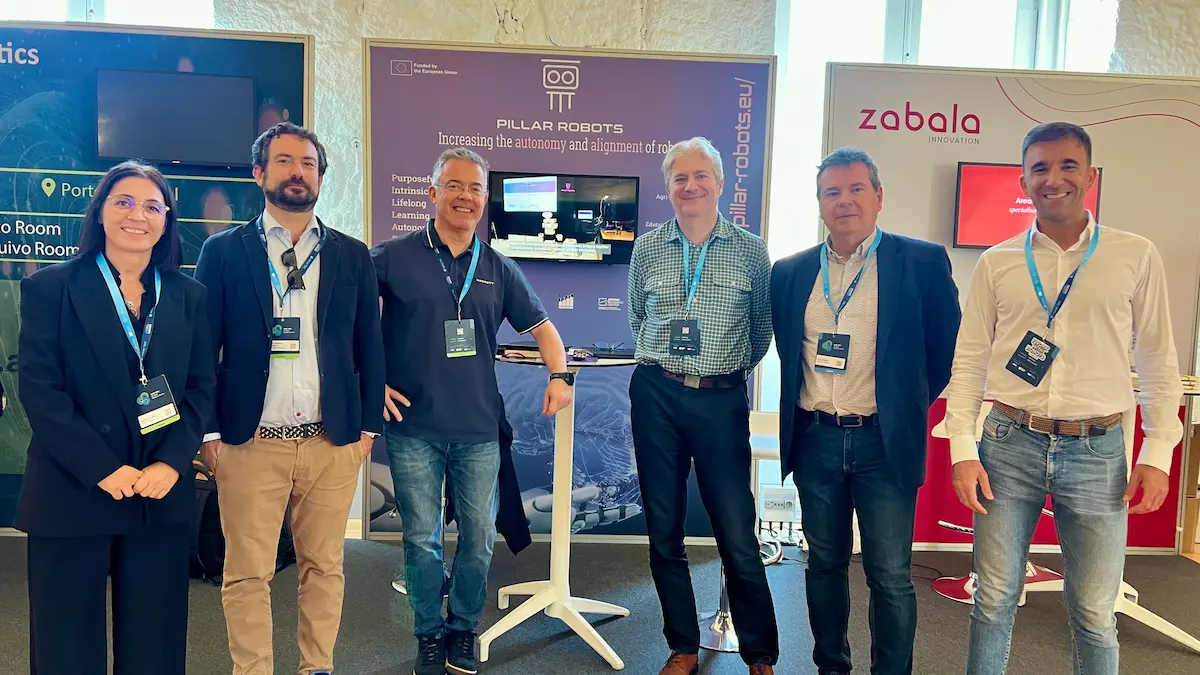
Bringing PILLAR-Robots research to the European AI and robotics community
PILLAR-Robots joined the AI, Data and Robotics Forum (ADRF 2026) in Porto, Portugal, bringing together project partners and the wider European robotics community as the project approaches the end of its four-year journey.
Held at the Alfândega Congress Centre, ADRF brought together researchers, industry representatives, policymakers and other stakeholders working across artificial intelligence, data and robotics.
For PILLAR-Robots, the event provided an opportunity not only to share the work developed throughout the project, but also to address a question that becomes increasingly important as autonomous robotic technologies mature: how can advanced research move successfully from the laboratory into real-world industrial deployment?
This challenge was at the centre of the PILLAR-Robots workshop “From Lab to Industry: Scaling Highly Autonomous Robots Under Regulatory Uncertainty.”
From research to industrial deployment
Highly autonomous AI-powered robots offer the possibility of operating and adapting in increasingly complex environments. However, moving these systems beyond research environments involves considerably more than technical performance alone.
Industrial adoption also depends on validation, trust, organisational readiness, viable routes to market and the ability to operate within a European regulatory framework that continues to evolve alongside the technology.
The workshop brought together perspectives from research, industry, ethics and policy to examine this transition and the conditions needed for highly autonomous robotic systems to achieve responsible and scalable real-world deployment.
Contributions from Richard Duro, representing the PILLAR-Robots research perspective, Stéphane Doncieux, bringing experience from European robotics research and euROBIN project, and Petros Maragos, representing HERON‘s research and innovation perspective, explored how developments in autonomous robotics can progress towards practical applications.
From the industrial side, Francesco Ferro, CEO of PAL Robotics, addressed the challenges involved in translating advanced robotics research into technologies capable of creating value in real operational environments.
Together, these perspectives highlighted a central issue for European robotics: closing the gap between successful research projects and technologies that can be reliably validated, transferred and scaled.
Regulation, ethics and autonomous robotics
As autonomous robots gain greater capacity to learn, adapt and make decisions, industrial deployment increasingly intersects with questions that cannot be addressed through engineering alone.
Legal uncertainty, ethical considerations, accountability, human oversight and societal expectations all influence how these systems can and should be introduced into real environments.
A key contribution to the workshop was therefore the presentation of the Policy Brief, developed through the project’s interdisciplinary work on the socio-economic, ethical, legal and technological implications of autonomous robotics.
The Policy Brief translates the work carried out within PILLAR-Robots into practical recommendations for policymakers, regulators, standardisation bodies, developers, providers, deployers, researchers and other actors involved in autonomous robotics.
Its recommendations address interconnected issues including context-dependent autonomy and learning, alignment under uncertainty, meaningful human oversight, equitable access to robotics, user safety and privacy, and legal responsibility when autonomous systems cause harm.
This policy perspective is particularly relevant as European organisations navigate evolving regulatory obligations such as those associated with the EU AI Act, alongside existing frameworks affecting machinery, data protection, workplace safety and other aspects of robotic deployment.
Building trust beyond the laboratory
One of the recurring themes of the session was that trust in autonomous robotic systems cannot simply be assumed because a technology has performed successfully in controlled conditions.
Moving from laboratory validation to deployment means operating in environments where circumstances, users and risks may change over time.
For this reason, the PILLAR-Robots Policy Brief advocates approaches including controlled pilots, gradual deployment, continuous monitoring and meaningful human oversight. These mechanisms can help organisations gather evidence about how autonomous systems behave in their actual operating context before progressively expanding their role or level of autonomy.
The workshop connected these governance considerations with the practical realities of industrial scaling: technical innovation, validation and policy foresight need to develop together if highly autonomous robots are to move reliably from research projects into widespread use.
Opening the discussion to the community
Rather than approaching these questions through a conventional presentation format, the workshop created space for direct discussion with participants.
The exchange provided an opportunity to connect the experiences of researchers developing new autonomous capabilities with those of industry actors considering deployment and stakeholders examining the ethical, societal and regulatory implications of these technologies.
This type of interdisciplinary dialogue is particularly important for general-purpose and adaptive robotic systems, where the same underlying technology may eventually operate across very different environments and under different levels of risk.
There is therefore unlikely to be a single model of autonomy, oversight or governance appropriate for every deployment. Understanding the context in which a robot operates remains essential for determining which capabilities, safeguards and forms of human control are appropriate.
Reaching the final stage of PILLAR-Robots
ADRF 2026 marked an important moment as PILLAR-Robots approaches the conclusion of four years of research into purposeful, intrinsically motivated lifelong learning autonomous robots.
Throughout the project, partners have explored how robots can acquire purposes, develop new skills and adapt their behaviour over time, while validating these capabilities across different application areas and examining their wider societal implications.
The discussion in Porto reflected the next step in that journey: moving from what autonomous robots can achieve towards understanding how those capabilities can be responsibly transferred, governed and scaled in the real world.
As autonomous robotics continues to progress, collaboration between research, industry, policymakers and society will remain essential to ensuring that innovation translates into technologies that are not only more capable, but also trustworthy, useful and ready for real-world deployment.